Notting Hill Carnival Sound System Map

Last year, I found myself lost somewhere between the thumping bass of a massive truck and a steel band that sounded like it was practicing for a world championship. My phone w...

Last year, I found myself lost somewhere between the thumping bass of a massive truck and a steel band that sounded like it was practicing for a world championship. My phone was dead, my friends were ghosts, and all I had was a half-eaten patty and a mounting sense of panic. Where was the good music? It felt like the entire carnival was conspiring to drown me in a soup of sound.
That’s when I stumbled into the real secret weapon of Notting Hill: the Sound System Map. Honestly, until that moment I thought the whole thing was just a chaotic, beautiful mess you stumbled into. You know that vibe? The map is the quiet genius hiding behind the chaos, the conductor of the world’s loudest orchestra.
Let’s be real: Notting Hill Carnival is not exactly “intuitive” for a first-timer. You’ve got two main “parades” of masqueraders, but the real soul lives on the static sound systems. These are the massive, custom-built speaker towers that anchor the entire weekend, each playing their own genre like a country of its own.
Must Read
Think of the Sound System Map as your treasure map, but instead of gold, you’re hunting for the perfect soca drop or a gritty, old-school reggae set. It’s a downloadable PDF or a scannable QR code that shows you exactly where every major system—like Channel One, Aba Shanti-I, or Rampage—is parked. Yes, it’s that simple. You’d think they’d sell it for a fiver.
Why This Map is Basically a Superpower
Without this map, you’re a leaf in the wind, getting pushed by the loudest noise. You’ll end up standing next to a guy with a dodgy speaker that’s just blasting static. No thank you. The map lets you curate your own sonic journey, jumping from the heavy dubplate of Aba Shanti-I to the high-energy jungle of Rampage in under ten minutes.
It also saves your legs. Notting Hill is spread over acres of West London terraced streets. Walking aimlessly for hours is a recipe for sunburn, hangry arguments, and blisters that’ll haunt you until Christmas.
Side note: Have you ever tried to find “that one good system” by sound alone? It’s impossible. The noise bounces off the houses and merges into a wall of bass that makes your eyeballs vibrate. The map is your only compass.
The Psychology of the “Sweet Spot”
Every sound system has a “sweet spot”—that magical radius where the bass hits your chest but the high-end doesn’t crack in your ears. The map helps you find it fast. You don’t have to linger near the back where it’s muffled, or right up front where your nasal passages get rearranged.
 Notting hill carnival 2014 map, travel and sound system guide | Metro News
I’ve seen people stand for an hour at a system they hated, just because they didn’t know a better one was around the corner. That’s tragic. The map is the ultimate decoder ring for sensory pleasure. Use it or lose your hearing.
Also, let’s talk about the social element. The map is passed around on WhatsApp groups, Instagram stories, and crumpled paper handouts near the tube stations. It’s a shared secret. When you pull out your phone and show someone the map, you instantly become their best friend for the next five minutes.
How to Actually Use It Without Looking Like a Tourist
First, download the PDF before you leave the house. The mobile signal in West London during Carnival is a joke. You’ll be staring at a spinning wheel of death while everyone else is dancing. Not a good look.
Second, don’t treat it like a strict itinerary. The map is a guide, not a dictator. You might plan to see Channel One at 3pm, but if you get sidetracked by a magnificent jerk chicken stall, honor that detour. The map is there to save you, not stress you.
Third, mark your favorites in advance. Most maps color-code by genre: reggae, soca, jungle, house, and soul. Pick two or three “must-visit” spots and let the rest be fluid. That way, you’re not frantically checking your phone every three seconds.
The Hidden Gems on the Map
Some systems on the map are absolute legends, but they’re tucked away on side streets no one walks down. You’d never find them without the map. There’s one near Ladbroke Grove that plays vintage lovers rock—a quiet oasis of soul in the middle of the mayhem. Pure bliss.
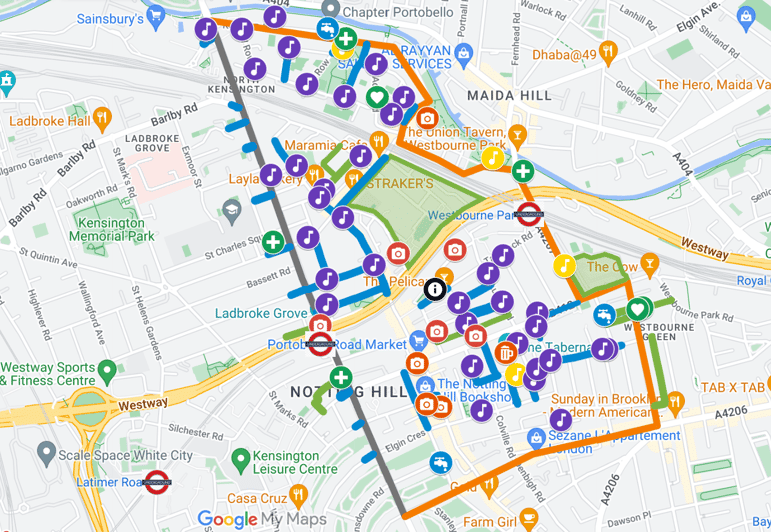 Notting Hill Carnival London - Interactive Map Guide | GetYourGuide
Then there are the rogue systems that pop up without official flags, but are listed anyway for the purists. These are the DIY crews running on generator power, sometimes with a sound technician who looks like he hasn’t slept since 1985. That’s where the magic lives.
I remember one map from 2019 showed a system called “Sunset Sound” in a tiny courtyard. We found it, and it was just forty people and a DJ playing slow-burning house music as the sun went down. It was the opposite of the main carnival energy, and it was perfect. The map made it possible.
The Irony of It All
Here’s the funny thing: the carnival is supposed to be this wild, anarchic explosion of culture. It’s loud, messy, and gloriously unorganized. But to enjoy it fully, you need a spreadsheet (well, a map, but same energy). The irony isn’t lost on me.
You get to be both a rebel and a planner. You can worship at the altar of spontaneous joy, but only after you’ve checked the map for the nearest toilet. That’s the Notting Hill way. Chaos with a side of logistics.
If you’re reading this on the Saturday before Carnival, stop what you’re doing and find the map. Print it, screenshot it, tattoo it on your arm—whatever works. Your ears will thank you. And your feet? Well, they’ll still hurt, but at least you’ll hurt in the right place.
So go. Get lost in the bass, find your sweet spot, and remember: the map is just a tool. The real secret is letting the sound take you somewhere you didn’t plan to go. Just don’t forget the map in your pocket.
