Is Soft Serve Healthier Than Ice Cream

Last summer, I watched my niece, Lucy, demolish a soft-serve cone from a roadside stand. She was three, and the smile on her face was a masterpiece of pure, unadulterated joy....

Last summer, I watched my niece, Lucy, demolish a soft-serve cone from a roadside stand. She was three, and the smile on her face was a masterpiece of pure, unadulterated joy. Meanwhile, I was nursing a fancy, hand-crafted, organic gelato that cost me twelve dollars. It was delicious, sure, but watching her made me wonder: was her cheap, swirly treat somehow winning the health game?
That’s the question, isn’t it? Is soft serve actually healthier than the “real” ice cream we obsess over? We’ve all heard the rumors that it’s “lighter” or “less fatty.” But let’s be real—we’re not eating this stuff for the nutritional value, right? I’m just curious if my guilty pleasure has a slightly less guilty edge.
The Great Dairy Showdown
Let’s get the science-y part over with, but fast. Traditional ice cream is a dense mix of cream, milk, sugar, and often egg yolks. Soft serve, on the other hand, uses more milk and less cream, plus a ton of air whipped into it. That air—usually about 50% of the volume—is the real secret here.
Must Read
Because soft serve is pumped with air, you get a bigger, fluffier cone for fewer actual ingredients. Gram for gram, traditional ice cream is a calorie bomb compared to the same weight of soft serve. But who eats by weight? You eat by volume—and that airy swirl builds up fast in your belly.
Calories: The Surprising Truth
A standard scoop of premium ice cream (like Häagen-Dazs) clocks in around 270 calories per half-cup. The same volume of soft serve? Roughly 150 to 180 calories. That’s a solid win for the machine-dispensed stuff. You save about a hundred calories on the same serving size.
But here’s the irony: a soft serve cone is never a precise half-cup. You’re getting a towering spiral that’s easily double that volume. So your “healthier” choice can turn into 300+ calories before you even reach the waffle cone. Classic trap, right?
Fat and Sugar: The Real Villains?
Soft serve generally has less fat because it uses milk instead of cream—usually 3–6% butterfat versus ice cream’s 10–20%. That’s a fact, and it’s why soft serve feels lighter on the tongue. But fat isn’t the only enemy in the room; sugar is the sneaky gremlin.
Here’s the kicker: soft serve often packs more sugar per gram than premium ice cream. Brands pump up the sweetness to make up for the missing fat flavor. So while you’re cutting fat, you might be getting a massive sugar spike that leaves you crashing an hour later. You’re basically trading one vice for another.
The Additives Factor
Let’s talk about the “weird stuff.” Soft serve relies on emulsifiers, stabilizers, and gums (like guar gum or carrageenan) to keep that airy texture from collapsing. Traditional ice cream might have fewer additives if it’s a high-quality brand. But honestly, are you really scared of a little guar gum? I’m not—it’s the sugar I’m side-eyeing.
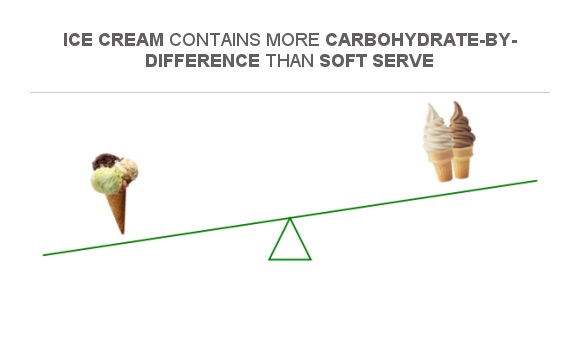 Compare Carbs in Ice cream to Carbs in Soft serve
Premium ice cream’s biggest advantage is its simplicity: cream, milk, sugar, eggs. Soft serve is a scientific miracle of processed engineering. If you’re a “clean eating” person, that’s a red flag. But if you’re a “I just want a cold treat” person, you probably don’t care.
Portion Control (Or the Lack Thereof)
The biggest health factor isn’t the ingredient list—it’s how much you eat. With ice cream, you usually scoop a bowl. With soft serve, you get a towering, Instagram-worthy monstrosity that you feel compelled to finish. It’s psychological warfare, and you’re losing.
I’ve never met a person who eats “just a small” soft serve. It’s always “Make it a double twist with sprinkles, please.” Meanwhile, a single scoop of gelato in a cup feels almost virtuous. So the soft serve is healthier only if you have willpower. And let’s be honest, do you?
What About the Toppings?
Oh, this is where it all falls apart. Soft serve is a vehicle for hot fudge, caramel, crushed Oreos, gummy worms—all the processed goodness. Ice cream can be eaten plain or with a simple berry compote. You’re not comparing apples to apples; you’re comparing a plain apple to an apple pie sundae.
If you eat both plain, soft serve wins on calories and fat. But the moment you add a brownie crumble, it’s game over. The health debate is really a toppings argument in disguise.
The Final Swirl
So is soft serve healthier? In a vacuum, yes—it’s less calorically dense and lower in fat. But in the real world, with human behavior and portion sizes, the difference is negligible. You’re better off picking the treat that makes you happy and eating less of it, period.
For me, I’d rather have one perfect scoop of rich, French vanilla ice cream than a tub of airy soft serve that leaves me feeling cheated. But Lucy? She’ll take the swirl, the mess, and the sugar rush every time. And maybe, once in a while, that’s the healthier choice for your soul. (Don’t quote me on that to your doctor.)
