What Is The Difference Between A Mile And A Kilometer

Okay, let’s settle this once and for all. You’re driving, and a sign says “50 miles.” Then your brain goes, “Wait, is that far? Is that close? What even is a mile anymore?” I’...
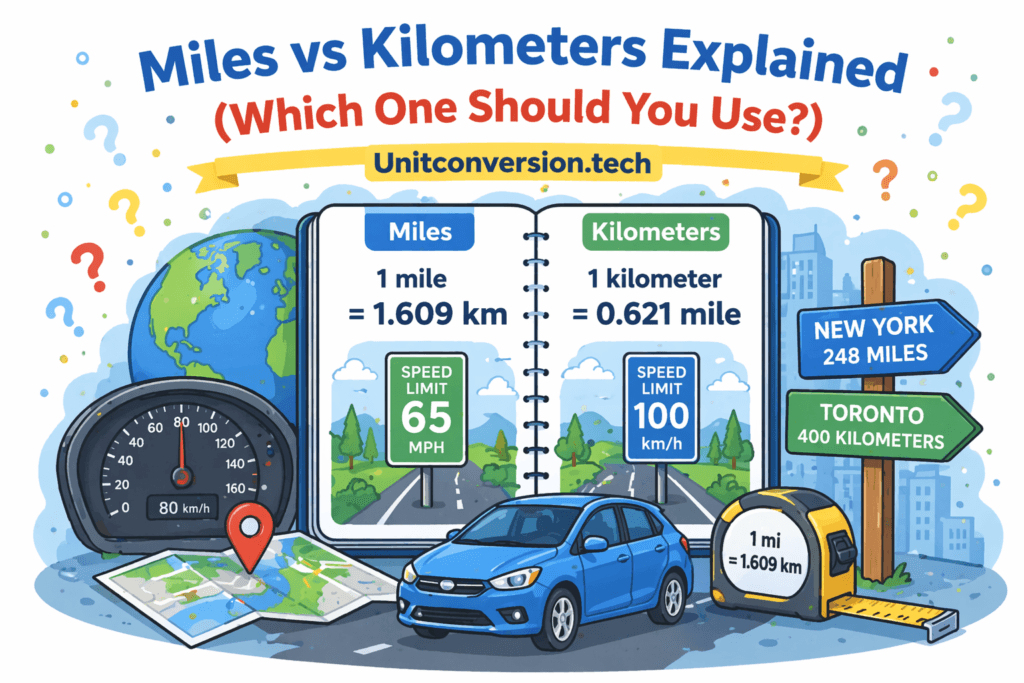
Okay, let’s settle this once and for all. You’re driving, and a sign says “50 miles.” Then your brain goes, “Wait, is that far? Is that close? What even is a mile anymore?” I’ve been there. It’s like a tiny panic attack over distance.
And then your European friend casually says, “Oh, it’s just 80 kilometers.” And you nod, but inside you’re screaming. What’s the difference? It’s simpler than you think. Let’s break it down like we’re gossiping about a mutual friend.
The Short, Brutal Truth
A mile is longer than a kilometer. Period. By a decent margin. Think of it this way: if a mile and a kilometer had a race, the mile would finish first and then order coffee while waiting for the kilometer.
Must Read
How much longer? One mile equals about 1.609 kilometers. So if you ever hear “90 miles per hour,” that’s not just fast—it’s a show-off. In kilometers, that’s nearly 145 km/h. Your European grandma would clutch her pearls.
Here’s the easiest cheat sheet: 5 miles is roughly 8 kilometers. Memorize that. It’s the golden key. 5 miles = 8 km. It’s not perfect math, but it’s good enough for brunch conversation.
Where Did These Weird Numbers Come From?
Oh, history is a beautiful mess. The mile comes from ancient Rome. No joke—soldiers marched 1,000 paces, and they called it mille passus. That’s Latin for “a thousand steps.” One pace = two steps (left foot, right foot). So a mile was literally 5,000 Roman feet. Fancy, right?
Then the English got involved, because of course they did. They tweaked it to 5,280 feet. Why? Because they felt like it. Actually, it’s tied to furlongs and farming, but let’s not go down that rabbit hole. Just know that 5,280 is the magic number.
Meanwhile, the kilometer is a child of the French Revolution. Very dramatic. They wanted everything in nice, tidy tens. One kilometer = 1,000 meters. That’s it. Clean, logical, and extremely French. (They also invented the metric system while drinking espresso. I’m fairly certain.)
Why Does America Still Use Miles?
Because we’re stubborn. That’s the polite answer. The real answer is that switching to kilometers would cost billions of dollars to change every road sign, speedometer, and GPS voice. It’s easier to just keep the weird Roman system.
Also, let’s be honest: “I ran a 10K” sounds impressive. “I ran a 6.2-mile” sounds like a Tuesday. The kilometer has a certain je ne sais quoi.
 Kilometer in Math – Definition, Example, Unit, Facts
But seriously, every other country on Earth uses kilometers. Even England, where the mile was born, mostly uses kilometers now. They kept miles for road signs, though—out of pure spite, I assume.
How to Tell Them Apart Without a Calculator
You’re at a party. Someone says, “It’s 10 kilometers to the beach.” Do you panic? No. You know that 1 km is about 0.6 miles. So 10 km = 6 miles. That’s a nice, easy jog. Or a short, annoying drive.
Want a visual? A kilometer is roughly the length of 10 football fields (including the end zones). A mile is about 17.6 football fields. Or, if you prefer: a kilometer is the distance you walk to get to the good taco truck. A mile is the distance you walk back after eating too many tacos.
Here’s another trick: when you see “km/h” on a speed limit sign, divide by 1.6 to get mph. So 100 km/h is about 62 mph. You’re now a conversion wizard. Use your powers responsibly.
The Emotional Difference
Let’s get deep for a second. Miles feel grand. They’re for road trips, epic hikes, and Holden V8s. Miles have swagger. Kilometers feel practical. They’re for commuting, track meets, and sensible hatchbacks.
But here’s the kicker: they measure the exact same space. Just in different accents. A mile is a kilometer in a cowboy hat. A kilometer is a mile in a beret. Both will get you where you’re going—one just takes a little more ego.
So next time you’re confused, just remember: 5 miles = 8 kilometers. Say it out loud. It’s your new party trick. And if someone corrects your math, shrug and say, “Close enough for government work.” Then walk away. You’ve earned it.
