Copper Switch Off In My Area

You’ve probably seen the letters drop through your letterbox, or maybe caught a snippet on the local news. The copper switch off is coming to your area, and it sounds a bit li...
You’ve probably seen the letters drop through your letterbox, or maybe caught a snippet on the local news. The copper switch off is coming to your area, and it sounds a bit like the plot of a retro sci-fi film. Relax. It’s not the end of the world—just the end of your landline as you know it.
In simple terms, telecom companies are finally retiring the old copper telephone network. This is the same infrastructure that has connected dusty rotary phones and crackling party lines for over a century. The big switch-off transfers everything to digital, fibre-optic technology, which is faster, sharper, and frankly, a lot more modern.
Think of it like trading in a vintage vinyl collection for a sleek streaming service. The soul is still there, but the delivery method is smoother. And yes, if you’re still clinging to a plug-in landline, you’ll need to adapt your habits.
Why Now, and Why Does It Affect My Area?
Copper cables are expensive to maintain and increasingly unreliable in a 4K, Zoom-call world. By switching off the old network, providers can focus all their energy on full-fibre broadband, which handles your Netflix binges and remote work with dramatically less buffering.
The roll-out is regional, so your neighbourhood might be on the list earlier than others. Check your provider’s website or a dedicated postcode checker—this is the digital equivalent of knowing when your street’s water mains are being upgraded. The timeline is usually staggered over several months, so you have time to prepare.
One fun fact: the copper network was originally designed for voice signals, not data. It’s essentially a 19th-century technology trying to handle 21st-century traffic. No wonder it’s finally taking a bow.
Practical Tips for the Switch
First up: check if your home broadband uses a copper line. If your router plugs into a phone socket with a standard ADSL or VDSL cable, you’re on copper. Fibre connections usually come with a dedicated wall box or an optical terminal.
Second: don’t ignore the letters. Many providers will send you a free digital phone or a new router plugging into fibre. If you ignore this, your old phone will simply go silent when the switch happens—no dial tone, no calls.
You might also need a battery backup unit if you rely on your landline for emergencies or have a medical pendant system. The new digital phones won’t work during a power cut unless you have a dedicated backup. Ask your provider about this—it’s a small but vital detail.
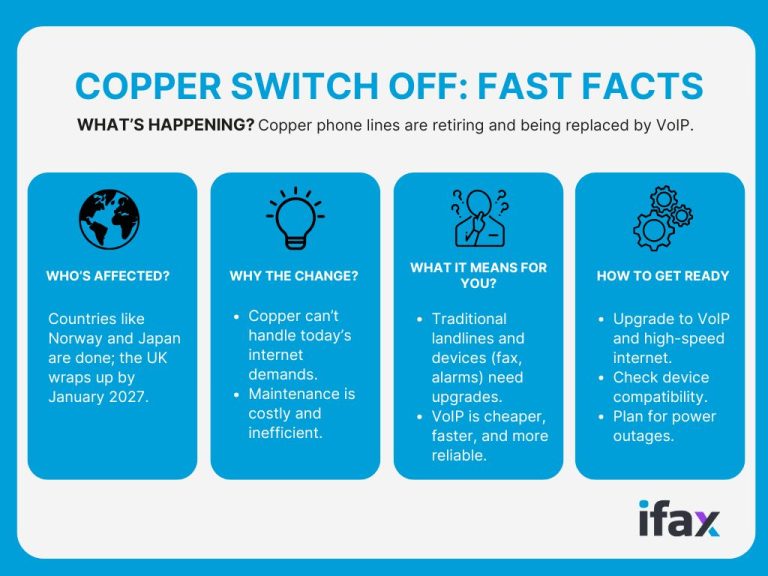 Copper Switch Off: What Will Happen and How Does It Affect You?
The Cultural Shift: Goodbye, Busy Signals
Remember the satisfying click-clack of a rotary dial? Or the distinct feeling of a busy signal meaning someone was gossiping on the line? The copper switch-off closes a chapter on that tactile, auditory nostalgia. We’re trading the grunt of a dial-up modem for the silent hum of fibre.
It’s a bit like saying farewell to the VHS tape or the physical newspaper. The convenience is undeniable, but there’s a wistful charm in those old copper wires. You can almost imagine them as the nervous system of a pre-smartphone world, carrying secrets and emergency calls through the walls.
On the bright side, no more crackling during thunderstorms. Your calls will be crystal clear, and you can finally say goodbye to that one dead spot in your kitchen where the Wi-Fi always drops.
Entertainment Angle: The “Digital Weight”
Here’s a light-hearted perspective: your home is about to shed physical weight. Copper cables are heavy, thick, and take up space. Fibre is thinner than a strand of hair. You’re upgrading your home’s information arteries without moving a muscle.
Think of it as Marie Kondo for your telecoms. Does that old junction box spark joy? Probably not. The new system is sleek, energy-efficient, and won’t leave rust stains on your skirting boards.
For the trivia lovers: the first commercial copper telegraph line was laid in 1844. That’s 180 years of service. The human lifespan is barely a fraction of that. Copper really held up its end of the bargain.
 What Will Happen to My Internet When the Copper Switch Off Happens
What About Your Gadgets?
Your standard landline phone will become an ornamental paperweight. But that’s okay—you can repurpose it as a retro planter or a quirky bookend. The real action is in your router, which will now handle voice calls using VoIP (Voice over Internet Protocol). It’s basically using the same tech as Skype or WhatsApp, but baked into your home line.
You might need to buy a new phone that plugs directly into your router, or use an app on your smartphone. Some providers give you a dedicated digital handset for free—it looks like a normal phone but works entirely over fibre. Don’t toss it aside; it’s your new gateway.
If you have an alarm system, fax machine, or old FTTP-compatible equipment, check compatibility. These devices often rely on the analogue signal copper provides. A quick call to your security provider can save you a headache later.
Reflection: Connection in a Quiet Way
When the copper finally goes silent in your area, take a moment. That network carried voices through wars, across cities, and into the quiet of your kitchen. It was the first thread that began stitching the world into a global village. Now, it’s being replaced by something faster, thinner, and perhaps a little less earthy.
But the essence remains: we all want to be heard, to check in, to laugh with a friend on the other end. The switch-off isn’t an ending—it’s a soft upgrade to how we stay close. Your next call will still connect you to someone who matters, only now it will arrive with zero static and a little more future.
So go ahead, plug in your new gear, test the clarity, and embrace the quiet hum of progress. Your old copper friend is clocking out, but the line stays open. And that, honestly, is what really matters.
