Difference Between Oceanic And Continental Crust

Ever wondered why the ground under your feet feels so solid, yet the ocean floor seems like a completely different beast? You’re not alone. Let’s talk about Earth’s two crusts...
-2.webp)
Ever wondered why the ground under your feet feels so solid, yet the ocean floor seems like a completely different beast? You’re not alone. Let’s talk about Earth’s two crusts: the oceanic and the continental—the planet’s ultimate odd couple.
One is a Heavyweight, the Other is a Floater
Think of the continental crust as a giant, chunky iceberg made of granite. It’s lighter, thicker, and likes to bob around on the mantle like a lazy pool float.
Meanwhile, the oceanic crust is like a lean, mean, dense slab of basalt. It’s younger, thinner, and sinks like a rock—because, well, it literally is one.
Must Read
Here’s the surprise: oceanic crust is only about 5 to 10 kilometers thick. Continental crust? It’s a chonky 30 to 70 kilometers deep. That’s like comparing a slice of pizza to a whole lasagna.
Age: The Baby vs. The Grandparent
If the oceanic crust were a person, it would be a teenager—always being recycled. It’s never older than 200 million years, which is a blink in Earth’s 4.5-billion-year timeline.
Continental crust is the grumpy old grandparent that refuses to die. Some chunks are over 4 billion years old, and they’ve been floating around like immortal couch potatoes.
Fun fact: oceanic crust is constantly being created at mid-ocean ridges and destroyed in subduction zones. It’s the planet’s most dramatic conveyor belt, and yes, it’s always on a recycling rampage.
Why One Sinks and the Other Doesn’t
Oceanic crust is made of denser rock, like basalt, which contains heavy minerals like iron and magnesium. It’s basically Earth’s version of a lead weight.
Continental crust is mostly granite, which is lighter and full of quartz and feldspar. It floats higher on the mantle, which is why we have dry land and not a water world.
Ever heard of isostasy? It’s a fancy word for “stuff floats at different levels.” Continental crust is the giant marshmallow, oceanic crust is the brick—and they both have to obey gravity’s judgment.
The Real Drama: When They Collide
When oceanic crust smashes into continental crust, it acts like a bully. It subducts, or dives under, because it’s heavier. This creates volcanoes, earthquakes, and the occasional tsunami that ruins your beach day.
But when two continental crusts collide—like India smashing into Asia—they don’t sink. They crumple, fold, and push up the Himalayas. That’s right: the tallest mountains on Earth are just crusts throwing a tantrum.
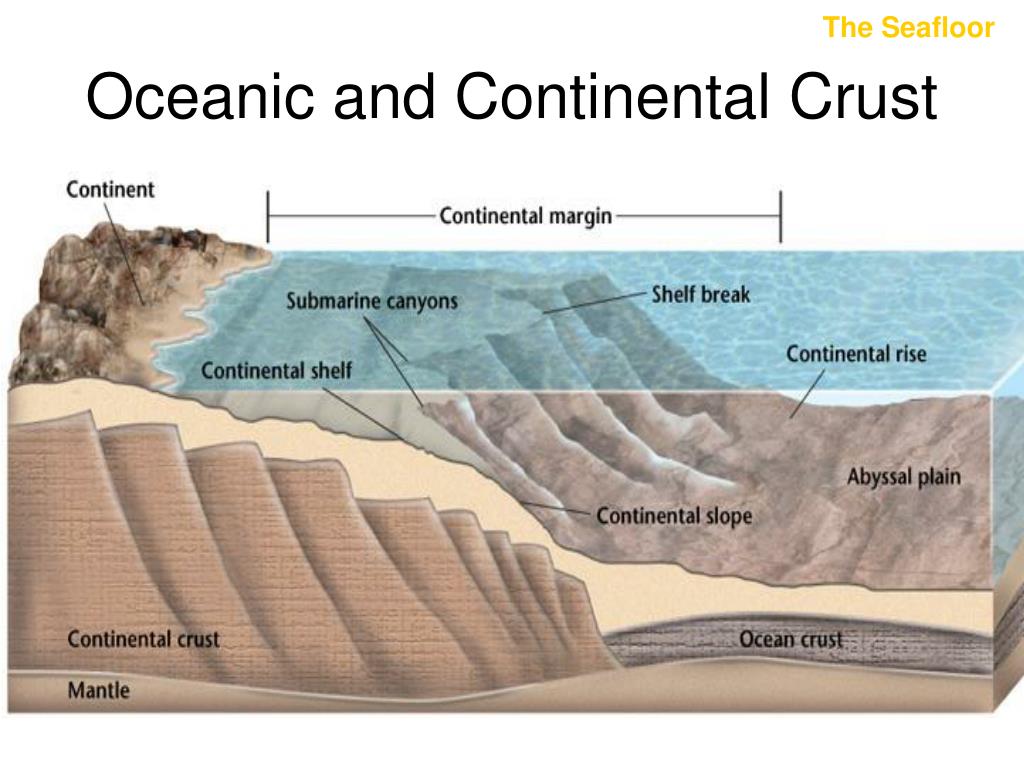 PPT - Oceanic and Continental Crust PowerPoint Presentation, free
Surprising fact: Mount Everest is made of ancient seafloor rocks that were once oceanic crust. So, the highest point on Earth started as the bottom of the ocean. Talk about a career change.
What’s Underneath? (Spoiler: It’s Hot)
Both crusts sit on the mantle, a layer of semi-molten rock that’s about 2,900 kilometers thick. It’s like a slow, churning lava lamp that moves tectonic plates.
Oceanic crust forms at mid-ocean ridges, where magma bubbles up and cools into new seafloor. Imagine Earth squeezing out a fresh layer of crust like toothpaste—except it’s hot rock and you can’t brush with it.
Continental crust is built mostly by volcanic eruptions and the accretion of older bits of crust gluing together. It’s messy, chaotic, and the result of billions of years of “let’s just pile it on.”
Why You Should Care (Besides Being a Smartypants at Parties)
Because the oceanic crust is denser and younger, it controls where earthquakes happen and where volcanoes pop up. Living near a subduction zone? You’re basically roommates with a ticking time bomb.
Continental crust is where we live, farm, and build cities because it’s higher and drier. Without it, we’d all be swimming, and humans are terrible at that.
Also, oceanic crust contains valuable minerals like copper and zinc, while continental crust holds gold, silver, and fossil fuels. So which one is richer? Technically, both—but one is under miles of water, so good luck mining it.
The Weirdest Difference of All
Oceanic crust is magnetic. As it forms, it records Earth’s magnetic field like a tape recorder. When the field flips, the crust shows stripes of reversed magnetism. It’s the planet’s most permanent polaroid.
Continental crust is not magnetic in the same way. It’s too old and mixed up, like a scrambled hard drive. Oceanic crust is the neat filing cabinet; continental crust is the junk drawer.
So next time you’re at the beach, remember: the sand you’re standing on is actually chewed-up continental rock, and the waves are hiding a thin, dense, magnetic teenager that might just swallow it all up. Enjoy your swim!
-2.webp&description=Difference+Between+Oceanic+And+Continental+Crust)