How Much Does It Cost To Summit Everest

So, you’ve been scrolling through Instagram, seen that iconic photo of the summit ridge, and thought, “Hmm, maybe I could do that?” Before you start shopping for puffy jackets...

So, you’ve been scrolling through Instagram, seen that iconic photo of the summit ridge, and thought, “Hmm, maybe I could do that?” Before you start shopping for puffy jackets, let's talk about the one question everyone asks but nobody wants to answer directly: the price tag. The simple truth is that climbing Everest isn’t just a physical challenge; it’s a financial one that can range from the cost of a nice sedan to the price of a suburban home.
We’ll break it down without the jargon, from the budget-friendly options to the “concierge-level” experiences. Think of this as your friendly, no-pressure guide to the economics of altitude. Because knowing the numbers is half the fun—and the other half is realizing you might need a second mortgage.
The Bare Bones: The Budget Climber’s Reality
If you’re looking for the absolute cheapest way to stand on the roof of the world, you’re looking at roughly $35,000 to $45,000. This is the no-frills path, often taken by experienced mountaineers who already own their own gear and can navigate the Khumbu Icefall blindfolded.
Must Read
This price typically covers a group permit, basic logistics, and a shared Sherpa support team. You’ll likely be on a less experienced operator’s roster, which means less hand-holding and more self-reliance.
A major caveat: this budget often doesn’t include your international flight to Kathmandu, personal gear, or the mandatory (and expensive) travel insurance that covers high-altitude helicopter evacuations. Don’t forget to budget an extra $5,000 for that insurance alone—it’s not glamorous, but it’s non-negotiable.
Fun Fact: The Permit Price Itself
Nepal charges a royalty fee just to let you try. For a foreign climber on a standard spring expedition, that fee is a whopping $11,000 per person. This single cost is often the biggest line item on your spreadsheet, and it covers zero food, oxygen, or Sherpa wages.
The Sweet Spot: The Standard Expedition
For most mortals, the “standard” package offered by reputable guiding companies is the way to go. Expect to pay between $45,000 and $75,000. This is your middle-ground experience, and it’s where the magic (and the oxygen tanks) start to flow.
This price usually includes a high-altitude guide, bottled oxygen (about four to five bottles), a personal Sherpa, all meals at base camp, and a solid tent setup. You’ll also get support with logistics like yak transport and porters to carry gear up the mountain.
Think of it as an all-inclusive resort, but with frostbite, 50 mph winds, and a bathroom that’s a bucket. You’re paying for the peace of mind that comes with knowing someone has your back when the altitude sickness hits.
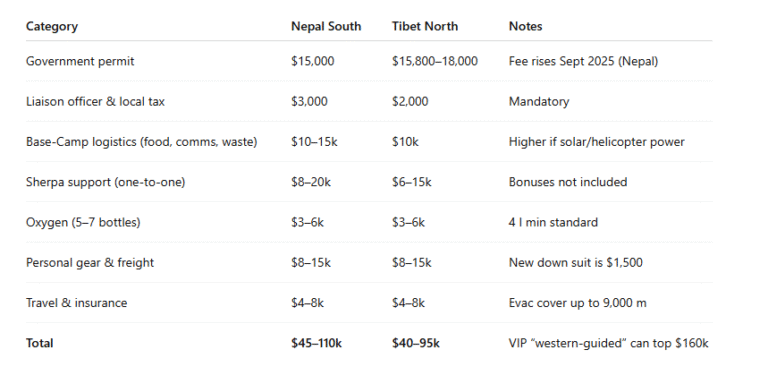 How Long Does It Take To Climb Mount Everest ? Timeline, Costs & More
The Luxury Option: The “Concierge” Summit
Then there’s the top shelf. If you want to summit Everest without carrying a single sleeping bag or eating freeze-dried pasta, the luxury tier is for you. Prices here start at $80,000 and can easily soar past $160,000.
What do you get for the price of a new Tesla? Private chefs serving fresh sushi, heated tents, satellite phones for daily calls home, and a dedicated team of Sherpas who handle every logistical burden. Some operators even offer personalized oxygen blending and a private doctor at base camp.
It’s the Nordstrom’s of mountaineering—efficient, comfortable, and wildly unnecessary, but incredibly tempting if you have the means. For this price, you might also get a helicopter ride from Lukla to base camp, skipping the famous (and terrifying) airstrip landing.
Cultural Insight: The Sherpa’s Role
Behind every successful summit is a team of Sherpas who make significantly less than their Western clients. While a Western guide might earn $10,000 to $30,000 per season, a high-altitude Sherpa typically earns $3,000 to $7,000. It’s a noble and dangerous profession, and ethical operators now emphasize fair wages and tips—often adding another $2,000 to your total.
The Hidden Costs That Sting
Here’s where the real price tag sneaks up on you. Beyond the expedition fee, you need to account for gear. A down suit alone can cost $3,000, and double plastic mountaineering boots are another $1,500. Then add a sleeping bag rated to -40°F ($800), climbing harness, carabiners, ice axes, and a high-quality headlamp.
Don’t forget the training. A serious aspirant will spend a year climbing Denali, Mont Blanc, or Aconcagua, which adds another $10,000 to $15,000 in courses, permits, and flights. You also need to budget for permits and visas for Tibet side routes (which can be cheaper, around $30,000 total, but politically trickier).
 Cost Of Climbing Everest – Climb Everest 2025 – EFVGA
And then there’s the trip cancellation insurance. If you get sick before you leave, you lose your deposit—which is often 50% of the total fee. That’s a $30,000 gamble on your immune system.
Practical Tips for the Dreamer
If you’re serious, start saving five years in advance. Open a separate “Everest fund” and contribute $500 a month. Most climbers finance this through a combination of savings, second mortgages, and selling belongings—or by becoming a professional speaker about their journey.
Another workaround: join a Nepalese operator (like Seven Summit Treks or Mountain Experience) rather than a Western company. They are often $20,000 to $30,000 cheaper, but require you to be self-sufficient in logistics. Also, consider climbing the less crowded north side from Tibet—it’s often 20% cheaper, but you’ll need a Chinese visa and a different set of permits.
Quick Reality Check
Here’s a fun fact: the average Everest climber spends 66 days on the mountain. That’s about $1,000 per day for a standard expedition. For comparison, a week at the Four Seasons in Bali is about $600 a day. You’re paying for the scarcity of oxygen, not the thread count of the sheets.
Final Reflection: The Mountain and Your Living Room
So, what does all this mean for your Tuesday? It means that the price of Everest is a reflection of desire, not just logistics. The $100,000 spent on the ice is not about the summit—it’s about the story you get to tell and the person you become in the process.
But here’s the truth that connects to daily life: you don’t need to climb Everest to have a summit. Every big goal—whether it’s starting a business, finishing a degree, or running a marathon—has its own “Everest price.” It’s your time, your energy, and your focus. The cost isn’t just currency; it’s the sacrifice of comfort.
So, next time you look at that instant Eskimo pie of a photo, remember: the real summit is the one you reach in your own life, the one where the price feels right. And if you do decide to write that check, just make sure you save enough for a good coffee when you get back down—because nothing beats the smell of a fresh brew at 17,000 feet.
