What Is The Temperature In Outer Space In Fahrenheit

Okay, let’s talk about outer space. You know, the big black void with all the twinkly stars and floating socks from lost spacecraft? What’s the temperature out there? If you’r...
Okay, let’s talk about outer space. You know, the big black void with all the twinkly stars and floating socks from lost spacecraft? What’s the temperature out there? If you’re picturing a giant freezer, you’re mostly right, but it’s way weirder than that.
First, let’s drop a little science-bomb: space doesn’t really have a temperature the way a cup of coffee does. Temperature is about molecules moving around—bumping into each other, getting hot and bothered. Out in the vacuum, there are almost no molecules to bump. It’s like trying to measure the heat of a party that nobody showed up to.
But scientists are clever. They measure the background radiation—the leftover heat from the Big Bang. That’s the “cosmic microwave background.” And get this: it’s about minus 454.8 degrees Fahrenheit. Yep, that’s absolutely freezing—only a few degrees above absolute zero (the coldest possible temperature in the universe). Absolute zero is -459.67°F, so space is basically a brrr-inducing -454.8°F.
Must Read
Wait, So It’s Always That Cold?
Not exactly. This is where it gets fun. In space, you can freeze and burn at the same time. Sounds like a bad relationship, right? If you’re floating near Earth, the side facing the Sun heats up to a toasty 250°F—that’s hot enough to melt a cheese pizza. Meanwhile, your shady side plunges to -250°F. Talk about split personality.
Imagine standing in a desert with one foot in a campfire and the other in a snowbank. That’s space. The vacuum acts like a perfect thermos—no air to carry heat away, so you either bake or shiver depending on where your astronaut boot is pointed. Spacecraft wear shiny blankets to reflect heat and stay cozy.
What About the “Cold” Parts?
Far away from any star, like in the deep void between galaxies, things get seriously chilly. The temperature can drop to about -455°F (roughly 2.7 Kelvin). That’s the cosmic microwave background we talked about. It’s the universe’s air conditioner, left running since the Big Bang.
But here’s a fun twist: even in that bone-rattling cold, space is not a uniform block of ice. There are clouds of gas and dust out there that are only a few degrees warmer. And near stars, well, you’re talking millions of degrees in their outer atmospheres (the corona). So the answer to “what’s the temperature in space?” is: it depends on where you’re standing. Or floating. Or being pulled into a black hole. Details.
Let’s Get Practical: What If You Went Outside Without a Suit?
Please don’t. But if you did, the vacuum would get you first—you’d explode (well, your fluids would boil, but it’s messy). Temperature wouldn’t matter because you’d have bigger problems. But let’s say you had a magic shield against vacuum. You’d still feel cold only where you’re not in sunlight.
In direct sunlight, your suit would cook like a baked potato. In the shade, you’d be a popsicle. That’s why astronauts have complex cooling and heating systems in their suits. It’s basically a space-age perfume for temperature. No joke, they even have underwear with tubes of water to keep them from turning into astronaut jerky.
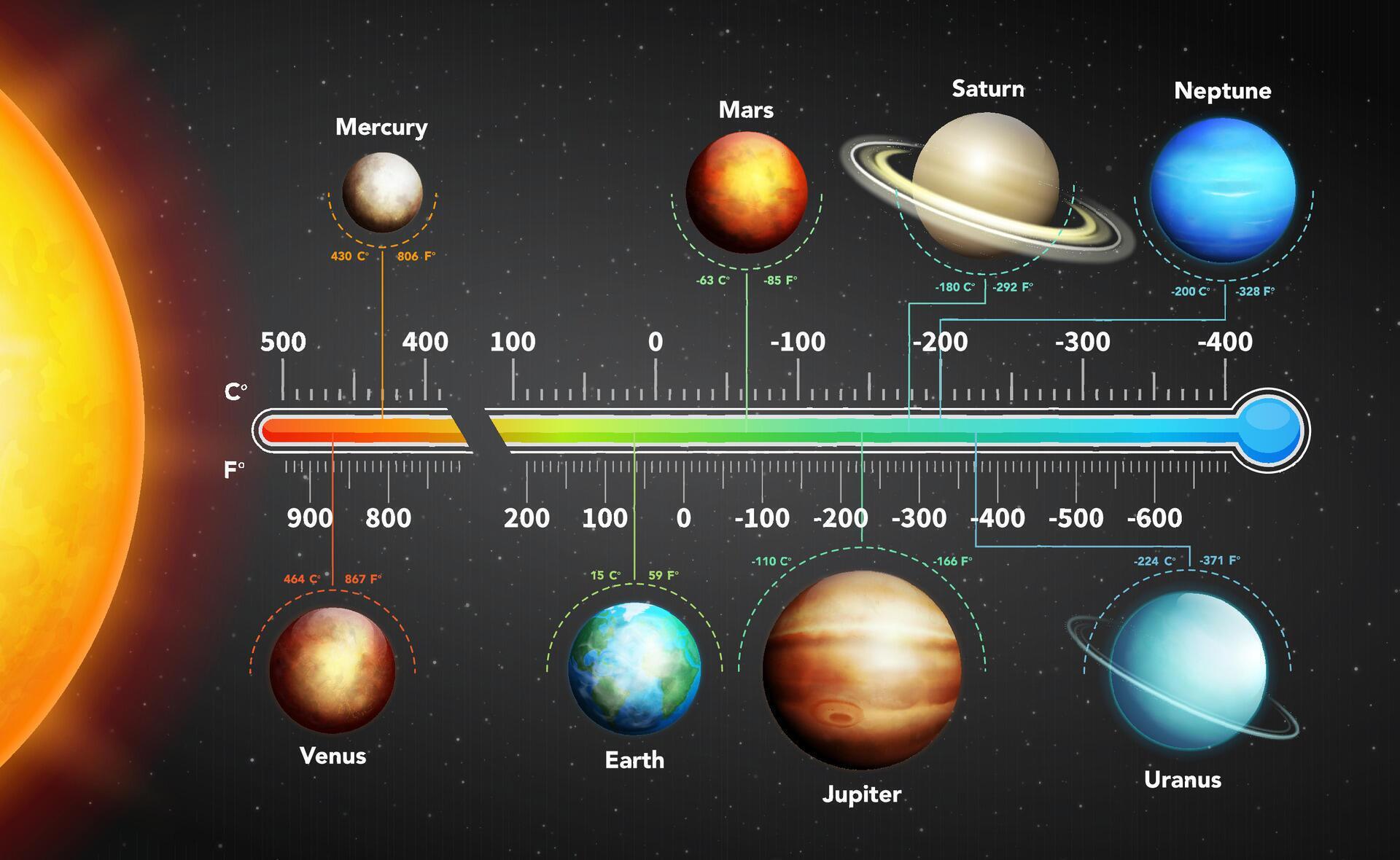
 Planet Temperatures Compared With Celsius And Fahrenheit Scale Chart
Why Does This Matter?
Because space is a snarky landlord—it charges extreme heat in the day and extreme cold at night. Every satellite and spaceship has to handle this temperature roller coaster. Engineers use gold foil, radiators, and even little electric heaters to keep things comfy. If a Mars rover gets too cold at night (like -100°F), it might refuse to wake up. Rude.
And here’s a mind-bender: the International Space Station wobbles between 250°F in the sun and -250°F in the shade every 90 minutes. That’s a 500-degree temperature swing every hour and a half. It’s like your oven and freezer doing a relay race. The station handles it by spinning slowly and using special radiators. We’re very fancy.
So… What’s the Final Answer in Fahrenheit?
If you want a number to impress your friends at a party: -454.8°F is the average background temperature of space. But really, it’s a moody chameleon. It’s cold where there’s no light, hot where there is, and sometimes both at once. The universe loves contradictions.
Next time you feel too cold in winter or too hot in summer, just remember: space has no central thermostat. It’s the ultimate “you figure it out” kind of place. And you’re not floating in a void—you’re standing on a rock that has a cozy atmosphere, a sun that keeps you warm, and a fridge full of ice cream. Pretty sweet deal, huh?
