What Is The Freezing Point Of Seawater

So, you’re wondering about the freezing point of seawater. Maybe you’re planning a polar expedition, or perhaps you just left a glass of saltwater in the freezer and found it...
So, you’re wondering about the freezing point of seawater. Maybe you’re planning a polar expedition, or perhaps you just left a glass of saltwater in the freezer and found it still slushy. Either way, welcome to the wonderfully weird world of frozen oceans.
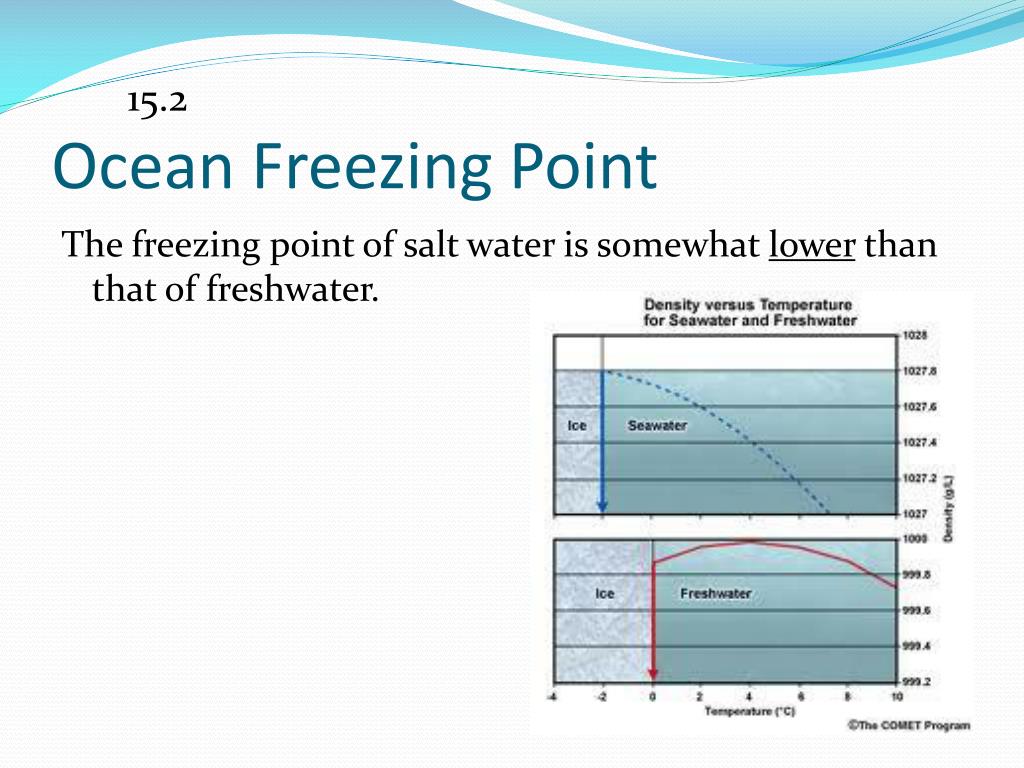
Here’s the short answer: Seawater doesn’t freeze at the same temperature as your tap water. While plain freshwater turns solid at 0°C (32°F), seawater needs to get much colder. We’re talking roughly -2°C (28.4°F).
Why the Big Difference? The Sneaky Salt
The culprit behind this icy delay is, of course, salt. You know how your mom told you to salt the driveway to melt ice? It’s the exact same principle, just in reverse.
Think of salt as a party crasher. Water molecules want to line up neatly to form ice crystals, but the salt ions barge in and mess up the formation. They basically yell, “Nope, too crowded to freeze!”
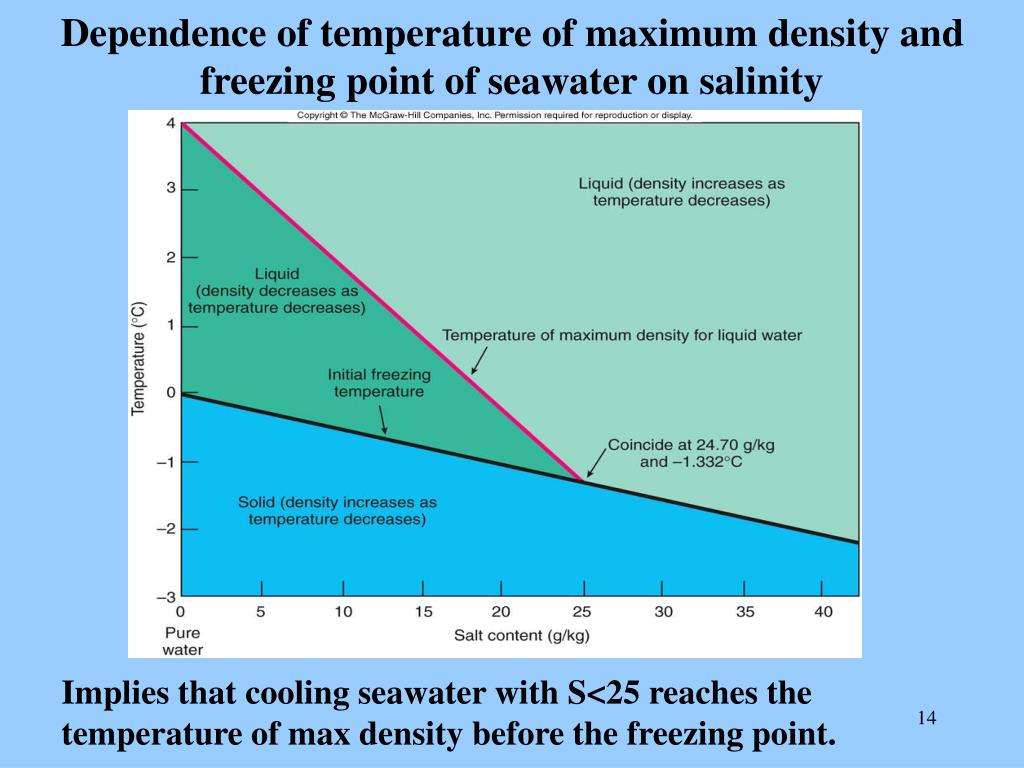
The result? The freezing point gets depressed—a fancy term for “pushed down.” The saltier the water, the lower the temperature needs to be for ice to form. It’s a cold, salty tug-of-war.
So, Is It Always -2°C? Not Quite.
The exact number depends on salinity—that’s the saltiness of the water. The average ocean has a salinity of about 3.5%, which gives us that -2°C freeze point.
But if you’re in the Baltic Sea? It’s less salty, so it freezes closer to -0.5°C. Head to the super-salty Dead Sea? You’d need to get it down to a chilly -21°C (-6°F) before it even thinks about freezing. Good luck with that.
So when someone says “the ocean freezes at 32 degrees,” you can gently correct them. Then you can run away while they’re distracted. (Just kidding. Mostly.)
 Freezing temperature of seawater at higher pressures for salinity 35 as
But Wait—If Seawater Freezes, Why Isn’t the Ocean a Giant Salt Lick?
This is the coolest part. When seawater freezes, the ice that forms is actually mostly freshwater. The salt gets pushed out as the crystals form.
Imagine a bouncer at a club. The water molecules are the VIPs, linking arms and forming a solid barrier. The salt ions? They’re the rowdy party-goers getting kicked out onto the sidewalk. That’s why old sea ice tastes almost like freshwater when you melt it.
This leftover salt makes the surrounding water even more salty and dense, which then sinks to the bottom. This process, called brine rejection, actually helps drive global ocean currents. So frozen seawater is basically the unsung hero of planetary climate control. Neat, huh?
Does This Affect Real Life? (Yes, and It’s Hilarious)
Ever wonder why ships in the Arctic don’t just freeze solid into the ice? It’s because the ice is less salty. So a ship can get trapped, but the hull isn’t usually destroyed by the salt concentration.
Also, this is why polar bears can drink melted sea ice. The ice is so low in salt that it’s relatively safe for them to hydrate. Meanwhile, the fish swimming below are doing just fine in that super-cold brine. They have special antifreeze proteins in their blood. Show-offs.
 PPT - Surface Circulation Pathways PowerPoint Presentation, free
And here’s a fun party trick: If you freeze seawater at home, the first ice that forms will be salt-free. The leftover liquid? That’s your super-concentrated brine. Do not drink it. Seriously, don't.
The “Does This Affect My Smoothie?” Factor
Probably not, unless you’re making a salty margarita slushy. But here’s the takeaway: Salt is a literal freeze point buster. It’s why we put salt on icy roads, and why the ocean can stay liquid enough for whales to swim in sub-zero temperatures.
Isn’t that just delightful? A little bit of salt messes with the laws of physics in the best way possible. It keeps the planet healthy, gives polar bears a drink, and ensures your ocean vacation isn’t ruined by spontaneous ice cubes the size of Volkswagen Beetles.
So, What’s the Verdict?
The freezing point of seawater is roughly -2°C (28.4°F), but it’s more of a sliding scale based on how much salt is in the mix. It’s not a single, rigid number—it’s a negotiation between water and salt.
And that, my friend, is science being wonderfully weird. It’s a reminder that even something as simple as “water freezes at zero” is actually a lie. Nature loves a plot twist.
So next time you’re sipping a cold, salty beverage (or just staring at the ocean), give a little nod to the brine. It’s out there, fighting the good fight against solid ice, keeping the world turning, and making sure polar bears get a decent drink. You salty, majestic hero, you.
